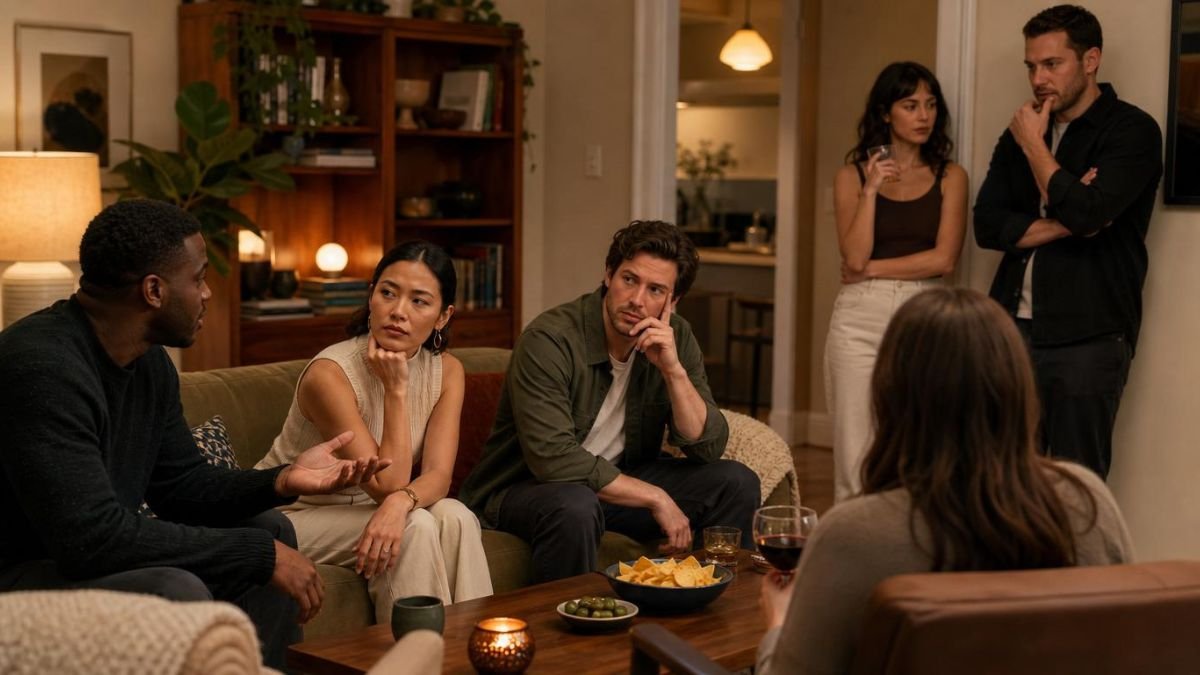
When did you learn to read something that had no words?
Because you did. At some point, without a single lesson, without a teacher, without a textbook, you learned to walk into a room and know. To feel the temperature of it before anyone said a thing. To sense, in the first three seconds, whether you'd walked into laughter or into an argument that had just gone quiet. And we have a phrase for that skill, and we use it so casually we've stopped hearing how strange it is. We say: read the room.
Read it. As if the room were a page.
But a room is not a page. It has no words on it. No one wrote the silence. No one printed the way that person is standing slightly turned away from that other person. No one typed out the tightness in a smile, the beat of hesitation before an answer, the way the air seems to hold its breath. And yet we call it reading. Because that is exactly what it is.
Think about what reading actually means. When you read these words, black marks on a surface, you are taking something that has no meaning in itself — shapes, lines, curves — and you are turning it into meaning. Ink becomes thought. Symbols become feeling. That's the miracle of literacy, and we're so used to it we forget it's a miracle at all.
Now, reading a room is the same miracle, but harder, and older. Older, because we could read rooms long before we could read letters. Long before there was writing, before there was a single word carved into a single stone, human beings were reading each other. Reading the tension in a shoulder. Reading the meaning of a glance held one second too long. Reading the difference between a silence that is peaceful and a silence that is about to break. That literacy kept us alive. The person who couldn't read the room didn't survive the room.
And here's what fascinates me. The text of a room is written in a language that everyone speaks and no one was taught. Posture. Distance. The angle of a body. The things people carefully aren't saying. The joke that lands and the joke that doesn't. The name that makes everyone go still. You know how to read all of it. You're reading it right now, in your life, all day, in every room you enter — and most of the time you don't even notice you're doing it. You just walk in and know.
But some rooms are harder to read than others. And here's the thing about this kind of literacy: it's the first thing that fails us when we stop paying attention to anyone but ourselves.
The person who can't read the room — you know the one. The person who tells the loud joke at the funeral. The person who keeps pushing their point after everyone else has quietly agreed to let it go. The person who brings up their good news in the exact moment someone else is breaking. We're often quick to call that person rude. But most of the time, it isn't rudeness. It's illiteracy. They genuinely cannot read the text that everyone else in the room is reading fluently. And the tragedy of it is that they're standing in the same room, receiving the same signals, and the language is simply not reaching them.
Because reading the room is not really about the room. It's about attention. It's about taking your eyes, for a moment, off yourself — off what you want to say, off how you're coming across, off the sentence you've already got loaded and ready to fire — and putting them onto everyone else. Reading the room is what empathy looks like when it becomes a skill. It's love, in a way, translated into perception. You cannot read a room you refuse to look at. You cannot read people you've stopped being curious about.
And here's the part that moves me. A room is a living text. It rewrites itself every second. A book holds still while you read it — the words don't move, the page waits for you. But a room is being written and rewritten by every person in it, all at once, continuously, and you are one of the authors. The moment you walk in, you change what's written. Your mood becomes part of the room's mood. Your silence adds to its silence. So to read the room is also to know your own line in it. To ask: what am I adding to this? What is my presence writing into this space right now?
That's a humbling question, and a beautiful one. Because it means reading the room is never just observation. It's participation. You read it so you can write into it well. You read the grief in the room so you can add gentleness. You read the joy so you can add to it instead of dampening it. You read the tension so you know whether to be the one who breaks it or the one who holds it.
We live in a time that rewards the opposite of this. We're taught to broadcast, to perform, to say our piece regardless of the room, to be authentic even when authentic means oblivious. And there's a place for boldness, I won't deny it. But I think we've quietly lost respect for the person who walks in, says little, watches, and simply understands. That person is not weak. That person is deeply, rarely literate. They are reading a text most people have stopped bothering to open.
So maybe that's the invitation hiding in this ordinary little phrase. Not just don't be embarrassing. Something bigger. Learn to read the language no one taught you. Pay attention to the words nobody said. Walk into a room and, before you decide what you're going to add to it, find out what's already written there.
Because every room you enter is a story in progress. And you get to choose whether you're the reader who understands it — or the one who talks over the whole page.
So here's what I'll leave you with. Think of the last room you truly read well — the moment you sensed exactly what someone needed before they said a word, and got it right. Now think of a time you missed it completely. What was the difference between those two moments? I suspect it wasn't your intelligence. I suspect it was simply where you'd pointed your attention. So the real question is this: whose room are you failing to read right now, because you've been too busy reading yourself?



0 Comments