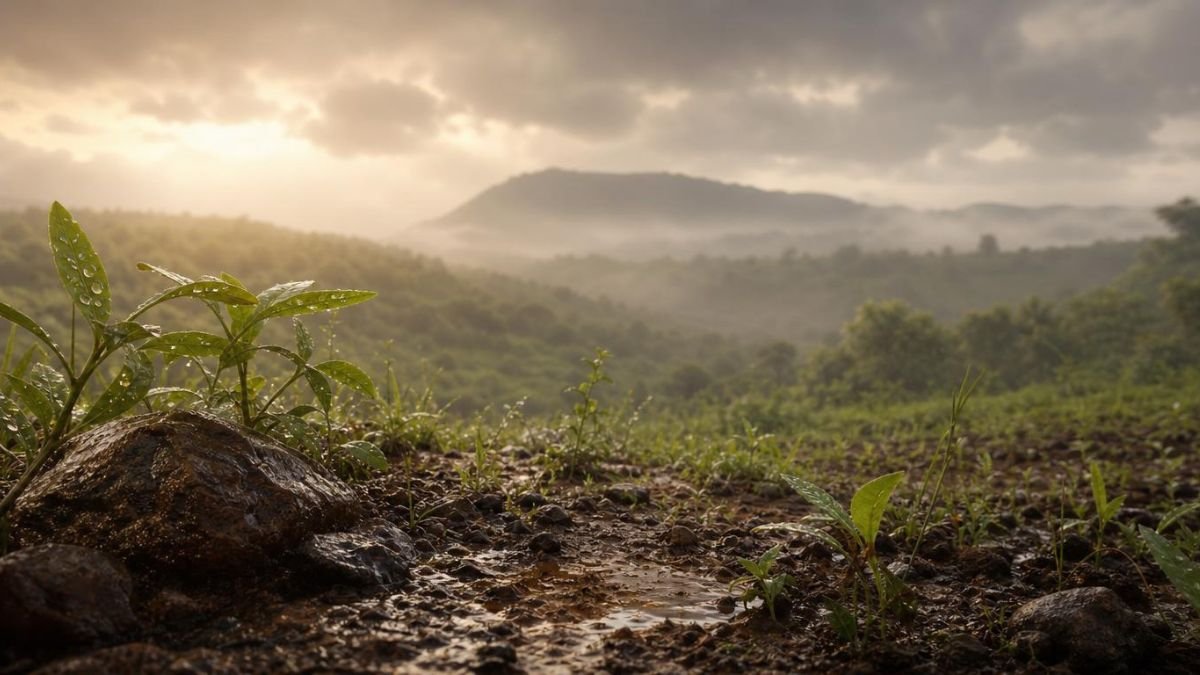
What do you call a smell you've known your whole life but never had a word for?
You know the one. It's the end of a long, dry spell — weeks of heat, the ground cracked and pale, the air thick and waiting. And then the first drops fall. And before you even feel the rain, you smell it. That sweet, earthy, almost mineral scent rising up off the ground, like the earth itself is exhaling. It's one of the most universally loved smells there is. Ask almost anyone, anywhere, and they'll know exactly what you mean. And yet, for nearly all of human history, it had no name.
Think about that. A smell so common, so beloved, so instantly recognizable to billions of people across every continent and every century — and language just, somehow, left it in the dark. We named the stars. We named diseases we couldn't see. But this thing, this daily miracle rising off the ground, went unnamed. It was a gap in the map of words. A beautiful thing hiding in plain sight, waiting.
And then, in 1964, two Australian scientists, Isabel Joy Bear and Richard Thomas, were studying exactly this. What is that smell, chemically? Where does it come from? And when they published their findings, they did something scientists don't always do. They didn't just explain it. They named it. And the name they chose is a small work of poetry.
Petrichor.
They built it from two Greek words, and this is where I want you to lean in, because the roots are more beautiful than most people ever realize. The first part, petra, means stone. Rock. You know it already — it's hiding inside words like petrify, to turn to stone. So far, so earthy. But it's the second half that stops me every time.
Ichor.
In Greek mythology, ichor was not ordinary blood. Ichor was the fluid that flowed in the veins of the gods. The immortals didn't bleed red like us. When a god was wounded, what ran from the wound was ichor — a golden, ethereal fluid, the very substance of divinity. It was what made them gods and not men. The blood of the deathless.
So put the two halves together and listen to what these scientists actually named that smell. Petra. Ichor. The blood of the stones. The ichor of the earth. They looked at the most ordinary thing — wet dirt, the smell of rain on rock — and they called it the golden blood of the gods, flowing up out of the ground.
And I think that's one of the loveliest things a word has ever done.
Because here's what's really happening, underneath the myth. That smell is real, and it has a real cause. During the dry weeks, plants release oils that settle into the soil and the stone. Certain bacteria in the earth produce a compound called geosmin — the word literally means earth smell. And when the rain finally comes, it strikes the dry ground and lofts all of that back up into the air, a fine mist of oils and earth-scent, and it reaches you on the wind before the storm even properly arrives. So the smell is, in the most literal sense, the dry earth releasing what it has been holding. It's the ground giving back what the drought made it store up. It is, quite exactly, the stone bleeding.
The scientists didn't invent the beauty. They just noticed it clearly enough to name it well.
And that's the thing I really want to sit with you on tonight. Not just the smell, but what it means to finally have a word for something. Because before 1964, you could smell petrichor and love it, and you could only point at it. That smell, you know, when it rains after it's been dry. You had the experience but not the handle. And there is something that happens to an experience when it finally gets a name. It becomes shareable. It becomes thinkable. It steps out of the fog of the merely felt and into the light of the sayable. Naming a thing is a small act of creation. Not because you made the thing — the smell was always there — but because you made a door into it that other people can walk through.
This is what words do, at their best. They don't decorate reality. They reveal it. They take the vast, wordless flood of what it's like to be alive — all the feelings and smells and half-noticed textures that wash over us every day — and they cut small windows into it, so we can point and say, that, I mean that, do you know it too? And the other person says, yes. Yes, I know it too. And suddenly you're not alone in the smell of the rain anymore. You have a word to meet each other in.
That's why I love that these two scientists reached past the plain and the technical and chose ichor. They could have called it rain-soil-volatile-compound-odor. It would have been accurate. It would have been dead. Instead they reached into an old myth and pulled out the blood of the gods, and they gave a poem to a puddle. They understood that some things deserve to be named beautifully, because the name is how the rest of us will hold them.
So the next time the dry spell finally breaks where you are — and living in this part of the world, you know exactly how long that wait can be — I want you to stand in that first minute of rain and breathe it in on purpose. And I want you to know that you're not just smelling wet ground. You're smelling the earth giving back what it was holding. You're smelling the stone bleeding gold. You're breathing in petrichor, and now you have the word for it, and the word is a small piece of the divine that two people bothered to hand down to you.
So here's what I'll leave you with. There are still things in your life you've felt a thousand times and never named — a specific loneliness, a particular kind of joy, a feeling that visits you and leaves before you can catch it. Petrichor waited until 1964 for its word. So I wonder: what nameless thing have you been carrying, unshared, unspoken, simply because no one has handed you the word for it yet? And what might change, the day you finally find it?



0 Comments