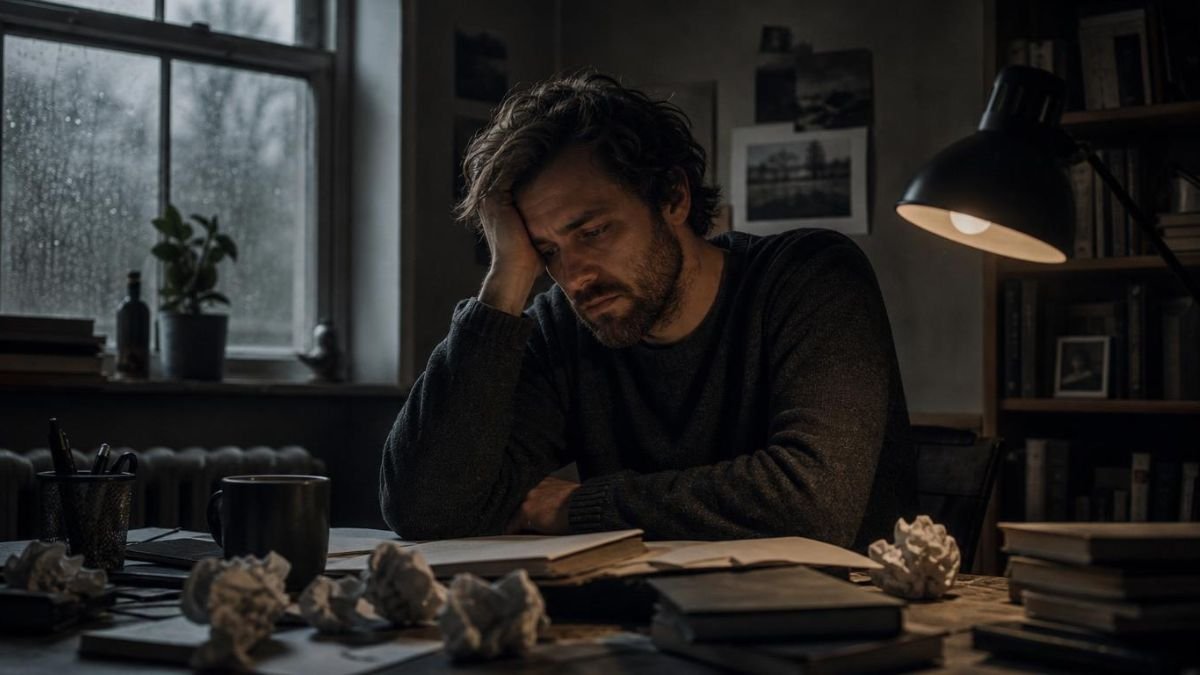
Let me get the disclaimer out of the way first, because apparently, in this particular conversation, we need one, and I'd rather hand it to you than have you spend the whole piece squinting at me and wondering whether you should call someone.
I'm not depressed. Right now, as I write this, I'm fine. Better than fine — I'm sitting somewhere warm, the coffee tastes like coffee, and I have the specific, quiet contentment of a person about to say something true. So please don't read this as a message in a bottle from the bottom of a well. It's a message from the porch, on a good day, from someone who happens to have spent a fair amount of time in that well and can describe the masonry from memory.
Because here's the thing. I'm not depressed. But I know its handwriting. And I'd recognize it anywhere.
You know how you can tell it's someone's letter before you read a single word — just by the slant of the pen, the way they cross their sevens? Depression has that. It has a specific hand. It writes to me in a very particular script, and after enough years I've learned to spot the envelope on the mat before I've opened it. That's what this is. Not a report from inside the storm, but a note from someone who knows what the sky looks like just before it turns.
And I want to tell you what I'm not going to do, because the not-doing is the whole point.
I'm not going to give you advice. I'm not going to suggest you try journaling, or a gratitude practice, or a brisk walk in nature, and I'm certainly not going to ask whether you've considered yoga, in that gentle voice people use when they've decided your despair is a scheduling problem. I'm not going to fix you, partly because I can't, and partly because being fixed is not actually what a person in the dark is usually asking for. What they're usually asking for — what I've always wanted, when it's been my turn — is much simpler and much harder to provide. They want someone to describe the thing accurately, so they feel a little less insane and a little less alone inside it.
So that's the deal I'm offering. No advice. Just a peek, and some company. I'll describe the handwriting, and if you know it too, we can look at it together, and neither of us has to pretend it says something it doesn't.
Now. Why writers?
Because we do seem to catch it. Not exclusively — depression is an equal-opportunity houseguest, it'll move in with an accountant just as happily as with a poet. But there's something about the people who make things out of words, and I've thought about it for a long time, and I think I finally understand the mechanism, and it's grimmer and more interesting than the cliché.
The cliché, of course, is the tortured artist. The romantic idea that the darkness is the fuel — that suffering is the price of the good stuff, that you have to bleed for the poem, that Van Gogh needed the anguish to see the stars like that. And I want to be very careful here, because that idea is not just wrong, it's dangerous. It's a lie that has cost people their lives, because it tells the sick person that the sickness is the source of their gift, so getting better means going quiet, means the well runs dry, means you'll be healthy and boring and unread. It dresses the illness up as a muse and hands you a reason not to fight it.
Let me say this plainly, because somebody needs to. Depression does not make you a better writer. Depression makes you a writer who cannot write. It doesn't sharpen the pen; it takes the pen away and convinces you that you never really knew how to use it and the things you made with it were embarrassing anyway. Whatever good work I've done, I did on the days I was well enough to do it, sometimes about the dark, but never or rarely from inside it. Nobody writes from the bottom of the well. You write about the well later, from the porch, which is exactly what I'm doing now. The dark is not the gift. The dark is the theft.
And that's the real reason writers are so exposed, and it took me years to see it clearly. It's not that we're more sensitive, though we tell ourselves that because it's flattering. It's that our entire job — the actual craft, the thing we do for a living — is the manufacture of meaning. A writer is a person who has committed, professionally, to the proposition that things matter. That a moment is worth describing. That a feeling can be named. That the details of a life add up to something you can hold in your hands and pass to a stranger. Our whole trade is the insistence that experience means something.
And depression is precisely, exactly, the disease that attacks that faculty. That's what it is, underneath the sadness and the sleep and the leaden mornings. Depression is the flat, total, unarguable conviction that nothing means anything, that it never did, that meaning itself was a story you were telling yourself, and now you can see behind the curtain and there's nothing there. It doesn't make you sad, not really. Sad would be a relief. Sad still believes things matter enough to grieve. Depression is worse than sad. Depression is the theft of the very ability to care that anything is happening at all.
So when it comes for a writer, it's not just suffering. It's an occupational hazard aimed with uncanny precision at the one tool we can't work without. It walks into the workshop and steals the specific instrument the whole trade depends on — the ability to believe that anything is worth writing down. A carpenter with a broken hand can still, at least, see that the table would be good if only he could build it. Depression takes the hand and the desire for the table and the concept of tables and, eventually, the memory that you ever wanted anything at all.
That's the handwriting. That's what the letter says. Not "you are sad." The letter says, in that flat, reasonable, patient voice, "none of this matters and it is never going to change and you have always known it." And the cruelest thing about the letter — the thing that makes it so hard to argue with — is that it doesn't feel like an emotion. It feels like a fact. It feels like clarity. It arrives disguised as the truth finally revealing itself, and you, the professional truth-teller, are uniquely equipped to be fooled by it.
Which brings me to the sunsets.
You know the ones. You're in it, you're flat on the floor of yourself, and someone who loves you — and this is important, they usually do love you, they mean it kindly — sends you an image of a sunset with a caption in a swirly font informing you that every storm runs out of rain. Or a reminder that you should be grateful, because someone somewhere has it worse. Or that inspirational graphic of the cartoon character telling you that you are enough, which is exactly the sort of thing that makes a depressed person want to lie face-down on the floor until the heat death of the universe.
I want to be fair to these people, because their hearts are in the right place, and I've been the person fumbling for something to say to a friend in the dark, and it is genuinely hard, and you reach for whatever's on the shelf. But I also want to be honest about why it lands so wrong, because the wrongness is instructive. Toxic positivity fails the depressed person for a very specific reason: it's an argument, and depression cannot be argued with, and being argued with when you're that far down doesn't feel like support. It feels like being told your reality is incorrect by someone who has never visited it. "Cheer up" is not a bridge thrown to a drowning person. It's a note shouted from a warm boat: have you considered not drowning? And the swirly font somehow makes it worse.
The deeper insult of the sunset meme is that it treats a sick person's despair as a bad attitude. As if the problem is that they've simply forgotten to notice the good things, and one well-chosen graphic will restore their perspective. But depression isn't a failure to notice the good things. Depression is the theft of the machinery that lets good things register as good. You can show a depressed person the most beautiful sunset in the history of the sky and they will look at it and feel the exact nothing they felt looking at the wall, and then, as a bonus, they'll feel broken for feeling nothing, because now there's photographic evidence that the world is beautiful and they're the one who's malfunctioning.
So, no sunsets. Not from me.
And here is where you might reasonably expect me to pivot, because we're deep into the dark now, and this is the part where the writer usually does a graceful little turn toward the light and starts reassuring you. And I'm going to turn toward the light, I promise, because I told you at the top there'd be hope at the end and I don't break promises to imaginary readers. But I refuse to do it with a sunset. I refuse to hand you a swirly-font consolation. If the hope isn't real, it's just another lie in a nicer typeface, and you deserve better than that, and frankly so do I.
So let me tell you what real hope actually is, in my experience, and where I've found it, and why it holds weight when the pretty stuff doesn't.
Real hope is not a feeling. That's the first thing, and it's the thing the memes get catastrophically wrong. Real hope is not the warm glow of believing things will be okay, because when you're in it, you can't summon that glow, and demanding it just adds failure to despair. Real hope is quieter and much sturdier than a feeling. Real hope is a thing you can hold onto precisely on the days you don't feel it. It's a fact you keep in your pocket, not a mood you have to generate.
And here's the first real fact, and it's a dark-humored one, so bear with me because I've earned the right to laugh at this from the inside. I have, to date, survived one hundred percent of my worst days. Every single one. The days I was absolutely certain I couldn't get through — I got through all of them, with a perfect, unbroken record, which is more than I can say for almost anything else I've attempted. That's not inspirational. That's just arithmetic. But it's real arithmetic, and on a bad day it's worth more than any sunset, because it's evidence, and depression's whole scam is telling you there's no evidence, that this is forever, that you've always felt this way and always will. The word "always" is where the letter lies. And you can catch it lying, because your own history is right there, contradicting it, one survived day at a time.
Which is the second real thing: the letter is recognizable. Once you've read depression's handwriting enough times, you learn to see the envelope for what it is. You can hold the thought — nothing matters, this is forever — and instead of receiving it as revealed truth, you can look at it and go, ah. There's the handwriting. There's that old, patient, lying script again. You don't have to believe it. You just have to recognize the penmanship. That recognition doesn't cure anything. But it puts a millimeter of glass between you and the lie, and on the worst days a millimeter of glass is the whole difference. It's the difference between being the storm and watching the weather.
And that's the third real thing, maybe the most important, and it's the one people with the recurring kind especially need to hear, so let me be careful and honest about it. For some people, the dark comes once and lifts and never returns. For others — and I count myself among them, and maybe you too — it's not a one-time storm. It's weather. It comes back. And the false hope, the sunset hope, promises you a cure, a permanent sunny day, and when the weather rolls back in, you feel doubly betrayed, because you were promised it was over. So I won't promise you that. Here's the real version instead: it moves. Whether it comes once or comes back a hundred times, it does not stay. It is weather, not climate. And you can build a life around weather. You can learn the season it tends to arrive in, and stock the pantry, and know that the sky which has cleared every single previous time will, on the evidence, clear again. That's not a cure. It's something better than a cure, because it's true. It's a way to live in a house you know sometimes floods, without pretending it never will, and without believing the flood is permanent when the water rises.
And the last real thing, the one I've saved for the end because it matters most and I didn't want to bury it: someone stays. Not to fix you. Not with a sunset. Just — someone sits in the room, unglamorously, and keeps you company in a silence that doesn't require you to feel better to justify their presence. I have had that. A person who didn't try to argue me out of the dark, who just refused to leave me alone in it, who understood that being witnessed is not the same as being cured but is, in its own quiet way, one of the realest things there is. That's not advice. I'm not telling you to go find that person; I know how impossible that instruction is from the inside. I'm just telling you it exists, because depression's letter swears you're fundamentally, permanently alone, and I have direct evidence that the letter is lying about that too.
So there it is. That's the hope, and I've tried to build it out of things you can actually stand on. Not "it gets better," in that bright, unbearable voice. Something smaller and much harder to break: it moves, you've survived every last one so far, the letter is recognizable as a letter, and someone can sit with you in the room. Those are real. I've tested them. They held.
I'm not depressed. I told you that at the start, and it's still true, and I'm grateful for it in the plain, unswirly way you're grateful for solid ground under your feet. But I know the handwriting, and I suspect some of you reading this know it too, and I didn't want you to have to look at that envelope alone. That was the whole point of this. Not to fix anything. Just to sit here on the porch with you, on a good day, and say: yes. I've seen that letter. I know exactly what it says. It's lying, in a few very specific places, and I can show you where.
Let's Think About This a Little Longer
No worksheet here, no five-step plan, because I meant it about the no-advice thing. But I do have some questions, and they're the kind you can carry around rather than answer on the spot.
Do you know the handwriting? If you do, what does the letter say to you specifically — what's the particular lie it likes to tell you, in that flat, reasonable voice that feels like fact? Sometimes just naming the exact sentence robs it of a little of its authority.
What's a piece of "hope" someone once offered you that landed completely wrong — and can you say why? I think there's real value in getting precise about the difference between the consolation that helps and the consolation that isolates, because most of us are, at some point, the person fumbling to comfort a friend, and it's worth knowing which shelf to reach for and which to leave alone.
And if you're on the other side of it right now — if you're the one trying to hold space for someone in the dark — what would it look like to just stay, without arguing, without fixing, without a single sunset? What would it cost you, and what might it be worth?
Here's the only thing close to a call to action I'll allow myself, and it's not advice, it's just a small human request. If someone you love has gone quiet lately, don't send the swirly-font graphic. Send yourself. Sit in the room. You don't have to say anything wise. Being witnessed is a real thing, one of the realest, and it asks nothing of you except that you don't leave.
And if you're the one in the room, on the floor, reading this because a friend sent it or the algorithm coughed it up at three in the morning: I'm not going to tell you it gets better in that voice. I'm going to tell you the truer, smaller thing. It moves. You've made it through every one so far. The letter is lying about the "always." And you are, whether it feels like it or not, being witnessed right now, by me, from the porch, on a good day, saving you a seat.


0 Comments