
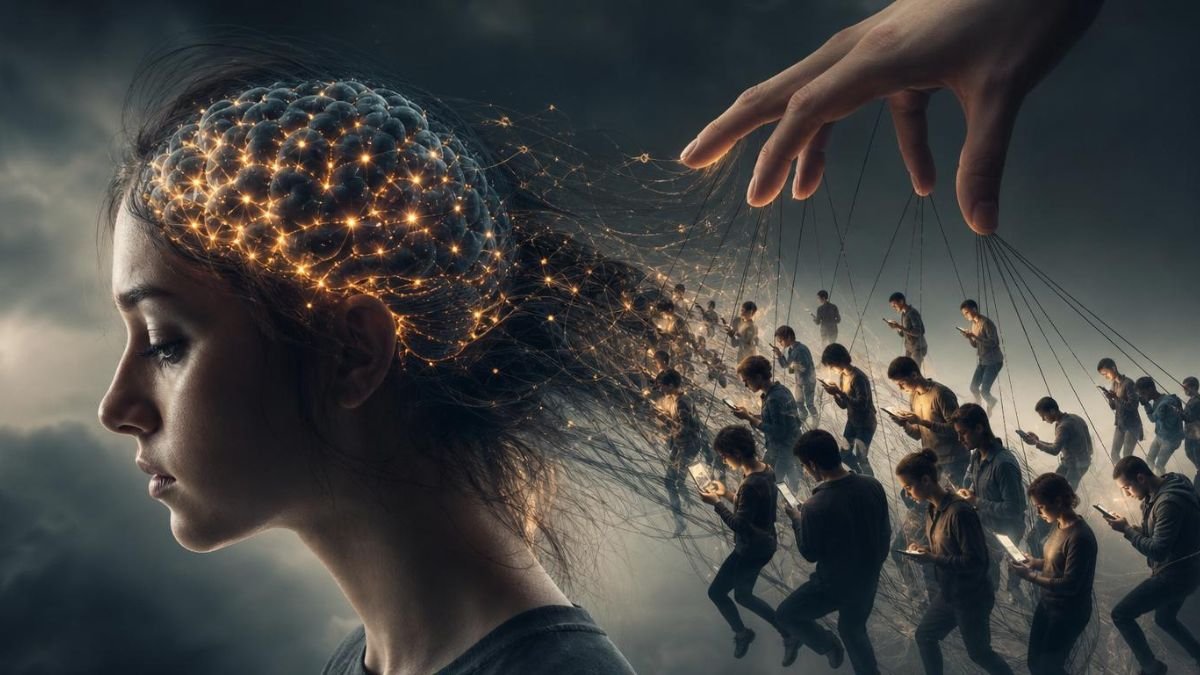
The Attention Economy and the Mind: The Most Valuable Thing You Own
Quick question, no judgment: when you woke up this morning, what was the first complete sentence your brain encountered? Was it a thought of your own — something you were turning over from the day before, a piece of a dream, a small plan — or was it a notification?
Most of us, if we are honest, will admit it was a notification. Mine was. A news headline I did not ask for, on a topic I did not choose, designed by people I do not know, to provoke an emotion I had not yet had time to feel. And the strange thing is that this no longer strikes most of us as strange. We have come to accept, almost without comment, that a stranger gets to write the first sentence in our head every morning.
This is our topic for today, and I want us to take our time with it. So pour something warm. Sit somewhere comfortable. Stay with me a little longer than feels easy. We will talk about how we got here, what it is actually doing to the inside of our heads, what is being overstated, what is being underestimated, and what — if anything — we can do about it without either pretending to be monks or pretending nothing is happening. There is a real conversation to be had between those two postures, and I think it is one of the most important conversations of our time.
The Price You Didn’t Notice You Were Paying
Here is the part nobody enjoys hearing, so I will say it kindly: you are not the customer. You never were. The customer is the advertiser. The product is your attention. And like any product, it has been studied, measured, optimized, and refined for one purpose, which is to keep producing more of itself in greater quantities.
This is not a conspiracy. There is no shadowy room. There is just a business model — a remarkably profitable one — that depends on a simple equation: more eyes on the screen for longer means more ads served means more revenue. Everything else follows from that. The colors of the icons. The shape of the buttons. The pull-to-refresh gesture (modeled, deliberately, on slot machines). The little red badge on the unread notification (designed, deliberately, to produce mild anxiety). The infinite scroll (the man who invented it has since apologized for it, which is the digital age in a single sentence).
If you have ever found yourself scrolling and thinking I do not even know why I am still doing this, I want to gently inform you: that is not a personal failing. That is the product working as intended. You opened an app that employs hundreds of engineers, designers, and behavioral scientists whose collective job is to outlast your self-control. Of course you lost. So did I. So did everyone.
Knowing that helps, I think. It moves the conversation from “what is wrong with me” to “what is happening here.” And those are very different conversations.
What This Is Actually Doing to You
Let us be precise, because precision is the antidote to panic. Most of what you have read about the attention economy is some mixture of true, exaggerated, and missing the point. The interesting questions live in the middle.
It is not, for example, particularly true that the human attention span has collapsed to eight seconds — shorter than a goldfish’s, as the famous statistic claims. The study is shaky, the comparison is silly (goldfish are surprisingly attentive little creatures), and your attention span has not been replaced with a postage stamp. You can still watch a four-hour movie when you want to. You can still get lost in a good novel, or a hard conversation, or a long walk.
What has changed — and this is more honest, and more uncomfortable — is your tolerance for the absence of stimulation. The baseline has shifted. When the brain has been trained, over thousands of small rewards a day, to expect a fresh hit of novelty every few seconds, the ordinary speed of real life starts to feel unbearable. The dinner conversation that does not deliver a punchline every minute. The book paragraph that does not pay off immediately. The meeting that requires you to sit with an idea before you respond. None of these have grown longer. You have grown less patient with them. There is a difference, and it matters.
There is a quieter cost too, one that gets less press because it is less dramatic. Sustained attention is not just how we get work done. It is how we turn information into knowledge. Reading a thing is not knowing a thing. Knowing requires that quiet, slightly boring back-of-the-mind processing where ideas connect to other ideas, where today’s news rubs up against last week’s reading, where something you half-understood three months ago suddenly clicks because your brain finally had a free moment to put it next to something else. That free moment is what the modern feed steals from you, not by being addictive in the dramatic sense, but by being available. There is always one more thing to look at, so there is never an empty minute. And empty minutes, it turns out, are where thinking happens.
I notice this in myself. I read more than I ever have. I retain less. There is no shortage of input. There is a shortage of digestion.
The Emotional Weather Inside the Phone
So far we have been talking about thinking. We also need to talk about feeling, because the attention economy is, more than anything else, an emotional environment — and a very particular one.
If you spend any time on social media, you live, several hours a day, inside a place where everyone is on their best behavior in the dramatic sense and their worst behavior in the moral sense. Their best behavior in the sense that you see only the curated highlight — the holiday, the promotion, the meal, the moment of triumph, the carefully chosen angle. Their worst behavior in the sense that the things rewarded most generously by the algorithms — outrage, contempt, mockery, certainty — happen to be the things human beings should probably be exporting from their personalities, not importing.
And we know, by now, that this is not an accident. Anger travels faster than other emotions on these platforms. Contempt produces engagement. Nuance does not. Slow, careful, partially-uncertain thinking — the kind that responsible adults are supposed to do — is structurally disadvantaged in an environment that rewards clicks, hearts, shares, and stays. So we get more of what works, and less of what is good for us, which is approximately the story of every empty-calorie food product ever invented, except this one is going into your head instead of your stomach.
There is something worth pausing on here. The platforms did not create human anger, vanity, or tribalism. These have been with us for a very long time. What the platforms have done, very efficiently, is industrialize them. They have built a delivery system for our worst tendencies and a suppression system for our better ones. And then, with admirable creativity, they have sold this back to us as connection. I am not sure there has been a sleight of hand quite this elegant in the history of commerce.
Let’s Be Fair to the Phone
Now — and this is where the letter would be dishonest if it did not pause — I want to push back on my own argument a little, because the standard attention-economy critique has its own blind spots, and pretending otherwise is its own kind of laziness.
First, there is something a little embarrassing about how much of this conversation is conducted by, and for, people who can afford to have it. The “digital detox” weekend, the cabin in the woods, the phone-free morning — these are not equally available to a single parent juggling three jobs, or a gig worker whose income depends on staying reachable, or a student in a remote town for whom the internet is not a distraction but a lifeline to the wider world. When I write about reclaiming your attention, I am writing, mostly, to people who have enough margin in their lives to reclaim things. That is not nothing, but it should be said aloud, because a critique that does not see its own class location is a critique that will be ignored by most of the people it claims to want to help.
Second, the framing of digital life as addiction is useful, but it is also, in a quiet way, very convenient — for the companies, I mean. If the problem is your dopamine system, the solution is self-help. If the problem is an industry that has chosen to operate without meaningful regulation while documented harms accumulate, the solution is political. Both framings have some truth. Only one of them threatens anyone’s business model. Notice which one tends to dominate the conversation.
Third, and most importantly: for an enormous number of people, the internet has been the best thing that ever happened to them. The queer kid in a small town who finally found their people. The artist who built a livelihood without a gatekeeper’s permission. The patient with a rare condition who, for the first time in their life, talked to someone else who had it. The educator whose classroom suddenly contains the world. We do not get to ignore these stories just because they complicate the doomscroll narrative. A serious conversation about the attention economy has to hold both truths: that the system is exploitative by design, and that the same wires carry an enormous amount of genuine human good. Most of life’s important things are like this — complicated, mixed, asking us to be more careful than we want to be.
So What Do We Actually Do?
Here is where most articles on this topic become unbearable, because they end with a list of tips about turning your screen grayscale and meditating for ten minutes a day, and you finish the list feeling vaguely shamed and entirely unchanged. I would like to avoid that. So instead of a checklist, let me offer a way of thinking that I have found genuinely useful.
The thing about willpower is that it does not work. Not at scale, not against a system engineered specifically to outlast it. You will lose, on average, every contest of self-discipline against an app that thousands of people are paid to make irresistible. The good news is that you do not have to win that contest. You have to avoid it. There is a difference between resisting a magnet and moving the magnet.
Practically, this means making the better behavior the easier behavior, and the worse behavior the harder one. Charging the phone in another room is not discipline; it is geometry. Turning off non-essential notifications is not asceticism; it is removing a small machine whose only job is to interrupt you. Choosing one block of the day where you are simply not reachable — and telling the people who matter to you that this is the rule — is not anti-social; it is the opposite. It is the rebuilding of attention so that you have any left to give the people who actually deserve it.
Alongside that, there is the slower work, the kind you cannot do by configuring an app. Rebuilding the capacity for sustained attention is genuinely like physical training. It is uncomfortable at first. It feels slow. Your mind, having been trained to expect a sugar rush of novelty, will resent the boredom of a long book or a long walk or a long thought. Stay with it anyway. The discomfort is not a sign that the practice is wrong. The discomfort is the practice. After a few weeks, something quiet starts to come back — a quality of presence, a depth of engagement, a willingness to sit with a thing until it actually reveals itself. You forget, until you have it again, how much of yourself you had been outsourcing.
And then, perhaps the most important and least mentioned piece: refuse the private framing of a public problem. Yes, change your habits. Yes, reclaim your own mind. But also notice that this is not only a personal matter. It is a political and economic one. The platforms could be regulated. The business model could be challenged. The defaults could be changed at scale, not just in your bedroom. The reason none of this has happened is not that it is impossible. It is that the industry that profits from the current arrangement has worked very hard to keep the conversation focused on you and your phone, rather than on them and their algorithms. Do not let the conversation stay only there. Both layers matter. The personal practice is what makes you a freer person. The political conversation is what makes a freer society possible. Neither replaces the other.
A Word About What This Is Costing Us
I want to close with the part that, honestly, I find hardest to write.
Your attention is, quite literally, your life. Not a feature of it, not a resource within it — it is the thing itself. Where your attention goes is, in the end, where you go. The hours add up. The decade adds up. And there is no version of your one human life in which the attention you have spent on infinite scroll counts as time well spent. I know this. You know this. We all know this. The hard part is that knowing it does not, on its own, change it. The infrastructure of distraction is built into the phone in your hand, and the phone in your hand is increasingly inseparable from the rest of your life.
But here is what I have come to believe, after sitting with this topic for a long time. The point is not to become someone who has perfectly managed their digital life. That person does not exist, and the people who claim to be them are usually selling you something. The point is to become someone who is in conversation with their own attention — who notices, who asks, who occasionally chooses. Most of what a medium does to you, it does invisibly. The first and most essential act of resistance, as McLuhan would have said, is recognition.
If this letter helps you recognize a little more of the water you are swimming in, it will have done its job. The rest is up to you, and to all of us, in the small daily acts of choosing where to look and the slightly larger civic acts of choosing what kind of attention-shaping industry we are willing to live with.
Your attention is the most valuable thing you own. Spend it like you mean it.
Questions Worth Sitting With
- When you reach for your phone without thinking, what feeling are you usually trying to escape? Boredom, anxiety, loneliness, awkwardness, a hard thought? It is almost always one of these. Naming it changes things.
- What is something you used to be able to do — read for an hour, watch a film without checking your phone, sit with a friend in silence — that has quietly become harder? You do not need to mourn it. But it might be worth noticing.
- Who profits from the way you currently spend your attention? Not abstractly — really. Whose business model is your screen time funding right now?
- Is your loudest opinion online something you genuinely hold, or something the environment rewards you for performing? These are not always the same thing.
- If you imagined the most attention-rich, present version of yourself — the one who is fully there for the people in front of them — what would have to change in the next twenty-four hours for you to be a little closer to that person?
A Small Call to Action
Try one thing this week. Just one. Not a system. Not a thirty-day program. One small structural change. Move the phone out of the bedroom. Turn off every notification except the ones from actual humans you love. Take a single uninterrupted walk without earbuds and let your mind wander where it wants to. Read a chapter of something long. Eat one meal without a screen.
Then notice what happens. Not what you achieved. What you noticed. That is the metric that matters. Attention is not a productivity tool. It is a way of being alive. Take some of it back this week, and tell me how it goes.
No Results Found
The page you requested could not be found. Try refining your search, or use the navigation above to locate the post.
No Results Found
The page you requested could not be found. Try refining your search, or use the navigation above to locate the post.
Recent Comments