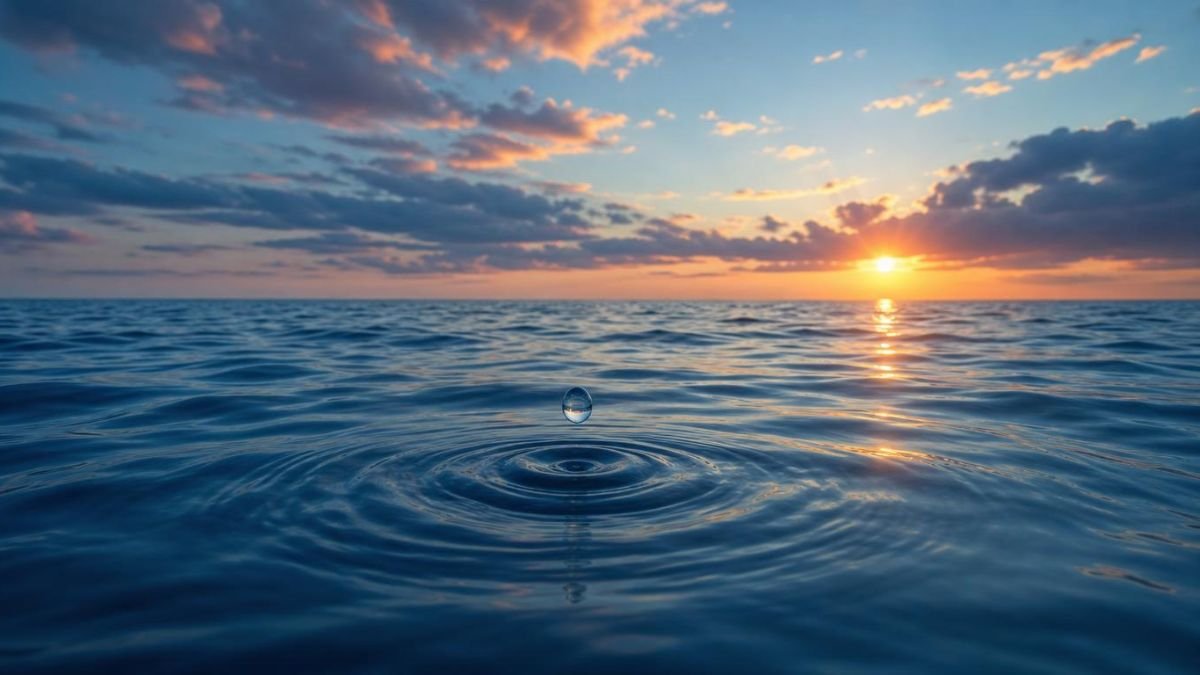
When you say your effort is just a drop in the ocean — have you forgotten what the ocean is made of?
I love this phrase, and I have a quarrel with it, and I want to bring you into both.
We say it when we feel small. You give what you can — a little money, a little time, a kindness, an effort — and then you look up at the size of the problem, at the size of the world, and something in you deflates. And you say it, half to explain yourself and half to excuse yourself: it's just a drop in the ocean. Meaning, it won't matter. Meaning, it's too small to count. Meaning, why even bother.
And I understand that feeling. I've felt it. You look at hunger, at war, at a planet's worth of suffering, and your one small act feels almost embarrassing next to it. A drop. Against an ocean. What's the point.
But here's where I want to gently turn the phrase over in my hands, like a stone I've picked up off a beach, and show you the other side.
What is the ocean?
Not poetically. Actually. What is it made of? It is made of drops. That's all. There is nothing in the ocean that is not a drop. The ocean is not some separate, enormous thing that drops fall into and disappear. The ocean is the drops. Every wave that has ever terrified a sailor, every tide that moves the whole planet's water, every vast blue thing you've ever stood in front of and felt tiny beside — all of it, without exception, is drops. Uncountable, individually insignificant, each one alone almost nothing. And together, the largest thing on Earth.
So when you say your effort is only a drop in the ocean, you've accidentally told the truth in the most hopeful way possible. Yes. It's a drop. And the ocean is nothing but drops like yours. You didn't describe your smallness. You described your belonging.
There's a line, often given to Mother Teresa, that goes something like: we feel that what we're doing is just a drop in the ocean, but the ocean would be less because of that missing drop. And I think about the quiet power in that. The ocean would be less. Not much less. Not noticeably less. But less. Subtract your drop, and the ocean is smaller, precisely by you. The math is unglamorous but it is exact. You are not decorative. You are constitutive. You are part of what the thing is.
Now, I want to be honest with you, because I promised you both my love and my quarrel.
The phrase is still trying to teach you humility, and it's right to. Here is the hard part of the drop. When a drop falls into the ocean, it stops being a drop. It loses its edges. You could not, if your life depended on it, go to the sea and find your drop again. It's gone. It has become water among water, indistinguishable, unnamed. There is no plaque on the wave that says this part is yours.
And that's the deal. That's the actual deal the phrase is offering you. If you want to be part of something vast, something that moves tides and shapes coastlines, you have to be willing to give up being seen as separate. You have to let your edges dissolve. The drop that insists on staying a drop, that refuses to join, that says I will only give if I get to stay visible and named and mine — that drop stays a drop forever. Small, whole, alone, and dry on the sand.
So the phrase holds two truths at once, and it will not let you have one without the other. It says: you are small. And it says: smallness is exactly what oceans are built from. It says: you will not be seen individually. And it says: you will be part of the largest thing there is.
I find something almost unbearably moving in that. Because so much of what actually holds the world together is drops that no one will ever count. The kindness you showed a stranger who never told anyone. The money you gave that fed a person you'll never meet. The patience you spent on a child who won't remember it but will become, because of it, a slightly gentler adult. None of it will be traced back to you. Your drop dissolved. And the ocean is larger, precisely by you.
We are so hungry, all of us, to matter in a way we can see. To point at the wave and say, that one, that's me, I did that. And the drop will never give you that. But it offers you something I've come to think is better. It offers you the chance to stop measuring your worth by whether you can find your own contribution in the finished thing — and start trusting that the finished thing simply could not exist without contributions exactly like yours.
So give your drop. Give it without needing to see the wave it becomes. Give it knowing it will vanish into water that has no name for you. That vanishing is not your effort failing. That vanishing is your effort working. That's what joining looks like.
The people who change things are almost never the ones who found a way to be a whole ocean by themselves. They're the ones who understood, early, that they were a drop — and gave it anyway, and gave it fully, and let it go.
So here's what I'll leave with you. The next time you're about to say it's only a drop in the ocean, and let yourself off the hook, I want you to finish the sentence differently. Say: it's a drop in the ocean — and the ocean is made of nothing else. And then ask yourself, honestly: what have you been holding back, keeping dry in your hand, afraid it was too small to give? And what might the ocean look like if you finally let it fall?

0 Comments